
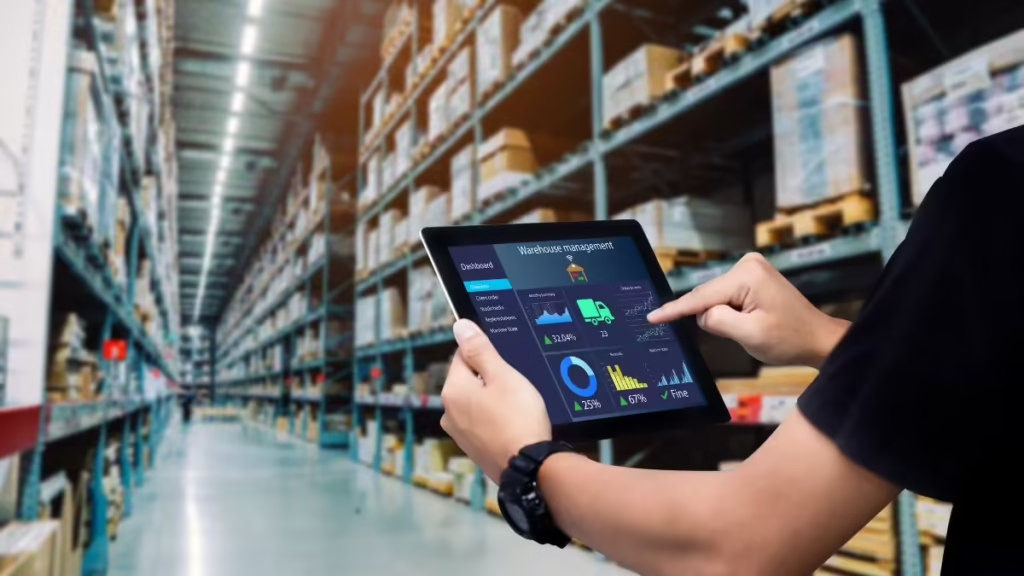
The future of warehousing lies in balancing advanced automation with the expertise of human labor. As warehouses face increasing demands for speed, accuracy, and efficiency, businesses must adopt systems that optimize both human and machine capabilities.
Warehouse Execution Systems (WES) are at the forefront of this evolution, enabling seamless collaboration between people and technology.
Coordinating Automation and Human Tasks
One of the most significant challenges in modern warehouses is coordinating tasks between automated tools and human workers. WES excels in this area by acting as a central command system that manages workflows in real time.
For instance, a WES can assign repetitive and physically demanding tasks, such as picking and sorting, to robots while directing human workers to focus on more complex or creative tasks. This ensures that resources are utilized effectively, boosting overall productivity.
Integration with Advanced Technologies
Another key feature of WES is its ability to integrate with advanced technologies like robotics, IoT devices, and artificial intelligence (AI). Robots equipped with sensors and AI capabilities can perform tasks with high precision, such as picking fragile items or assembling orders.
At the same time, WES coordinates these activities with human workflows, ensuring that machines and workers operate in harmony. This integration minimizes downtime, reduces errors, and enhances the speed and accuracy of operations.
Real-Time Data-Driven Decision Making
Real-time data analysis is another area where WES shines. By collecting and processing data from various sources, such as IoT-enabled devices and automated systems, WES provides actionable insights that improve decision-making.
For example, a WES can analyze inventory levels and forecast demand, allowing warehouse managers to adjust stock levels proactively. This ensures that products are always available when needed, reducing the risk of stockouts or overstocking.
Scalability and Flexibility for Growth
Flexibility and scalability are critical as warehouses evolve. WES is designed to adapt to changing business needs, whether it involves integrating new automation technologies, handling larger order volumes, or expanding to additional locations.
This scalability ensures that WES remains a valuable tool as businesses grow and face new challenges. For instance, a growing warehouse might integrate automated guided vehicles (AGVs) into its operations, and WES can seamlessly incorporate these tools into existing workflows.
Supporting Sustainability in Warehousing
WES also plays a crucial role in creating a sustainable warehouse. By optimizing workflows and minimizing waste, WES helps reduce energy consumption and environmental impact.
For example, intelligent routing algorithms can minimize travel distances for both robots and human workers, cutting down on fuel usage and emissions. This focus on sustainability not only benefits the environment but also lowers operational costs, creating a win-win situation for businesses.
Enhancing the Role of Human Labor
Human labor remains an indispensable part of warehouse operations, and WES enhances workforce efficiency by orchestrating workflows and optimizing the use of automation tools.
Instead of performing repetitive tasks, workers can focus on higher-value activities as WES ensures that robots, conveyors, and other automated systems handle routine operations like picking and sorting.
This not only improves employee satisfaction but also reduces turnover rates, fostering a more stable and skilled workforce.
Empowering the Future of Warehousing
The future of warehousing depends on the seamless integration of automation and human labor, and WES is the key to achieving this balance. By coordinating workflows, optimizing resource allocation, and enabling real-time decision-making, Warehouse Execution Systems empower warehouses to meet the demands of a rapidly changing logistics landscape.
Businesses that adopt WES will not only improve their operations but also position themselves for long-term success in an increasingly competitive market.