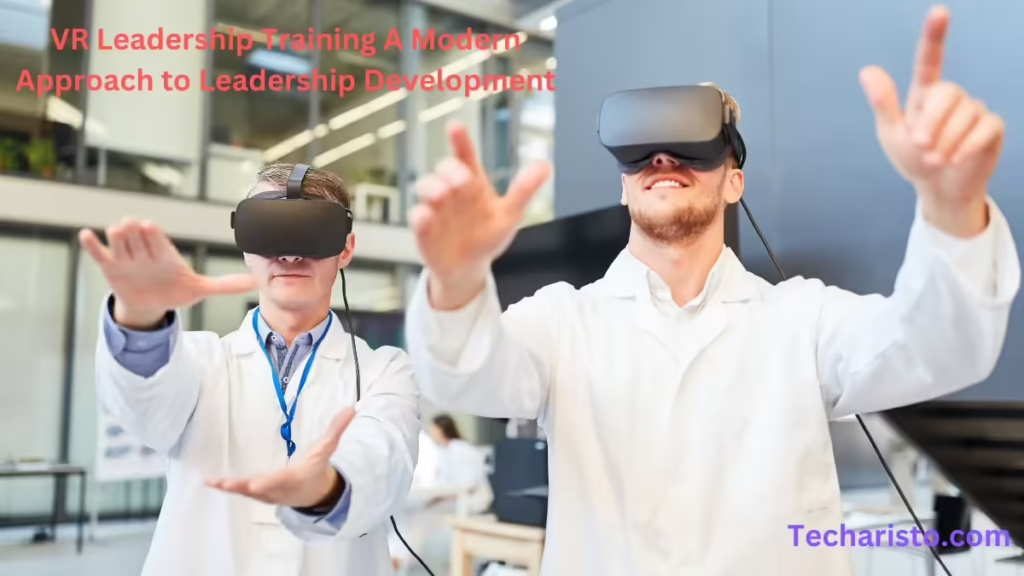
VR leadership training is transforming the way organizations nurture and develop leaders by providing immersive, practical experiences in virtual environments. Traditional leadership programs often rely on lectures, case studies, or role-playing exercises that, while valuable, lack the realism and engagement necessary to simulate real-world challenges effectively.
Virtual reality, however, creates dynamic, interactive environments where future leaders can practice decision-making, communication, and crisis management with unparalleled realism.
The power of immersive VR leadership training
VR leadership training goes beyond traditional learning methods by placing participants directly into lifelike scenarios where their leadership skills are put to the test.
Platforms like Mazer are at the forefront of this innovation, offering customized virtual modules that recreate realistic challenges leaders face daily. These simulations allow individuals to make critical decisions, assess their outcomes, and refine their approaches in a risk-free setting.
Through virtual reality, leaders can practice essential skills such as conflict resolution, team management, and strategic thinking while interacting with virtual team members or managing simulated projects.
By engaging in these hands-on scenarios, participants build confidence and decision-making skills that are directly transferable to real-world situations. The immersive nature of VR ensures that learners remain fully engaged, fostering deeper understanding and long-term retention of leadership principles.
Key benefits of VR leadership training
One of the most significant advantages of VR leadership training is its ability to create safe yet challenging learning environments. Leaders can experiment with different approaches and experience the consequences of their decisions without real-world risks.
For example, they may navigate complex interpersonal conflicts, handle a crisis under pressure, or motivate a team during a simulated business setback. This approach enables leaders to refine their emotional intelligence, problem-solving abilities, and communication skills in a controlled space.
Additionally, VR leadership training provides measurable insights into a participant’s progress and decision-making patterns.
Advanced analytics embedded within VR platforms, such as Mazer, track performance metrics and offer data-driven feedback on strengths and areas for improvement.
This allows organizations to identify skill gaps and tailor leadership development programs to meet individual needs more effectively.
Another key benefit is scalability and accessibility. VR leadership training eliminates geographical barriers, allowing organizations to train leaders across global teams simultaneously.
Moreover, because VR simulations are repeatable, learners can revisit scenarios as often as necessary, ensuring mastery of specific skills. This level of flexibility makes VR a cost-effective solution for large-scale leadership training programs.
Realistic applications across industries
The value of VR leadership training extends across industries, from corporate enterprises to healthcare and education. Organizations operating in fast-paced, high-stakes environments can particularly benefit from VR’s ability to simulate real-world challenges.
Leaders in sectors such as finance, manufacturing, and retail can hone their decision-making skills in scenarios involving market changes, operational setbacks, or team performance issues.
In healthcare, for instance, leadership training might focus on managing crisis situations, such as medical emergencies or staff coordination during high-pressure events.
For educators and administrators, VR can simulate team-building exercises and facilitate the development of communication strategies to manage diverse teams effectively.
Conclusion
VR leadership training represents a revolutionary shift in how organizations prepare leaders to thrive in today’s complex and dynamic work environments. By offering immersive, hands-on simulations, virtual reality bridges the gap between theory and practice, providing aspiring leaders with practical experience in decision-making, conflict resolution, and team management.
Platforms like Mazer demonstrate how technology can transform leadership development, delivering measurable results while fostering confidence and adaptability. As organizations continue to embrace innovation, VR leadership training will play an increasingly vital role in cultivating the next generation of effective and resilient leaders.